Building the Tissue Viability Vet Nurse Role

- Description
- Curriculum
- Reviews
- Grade
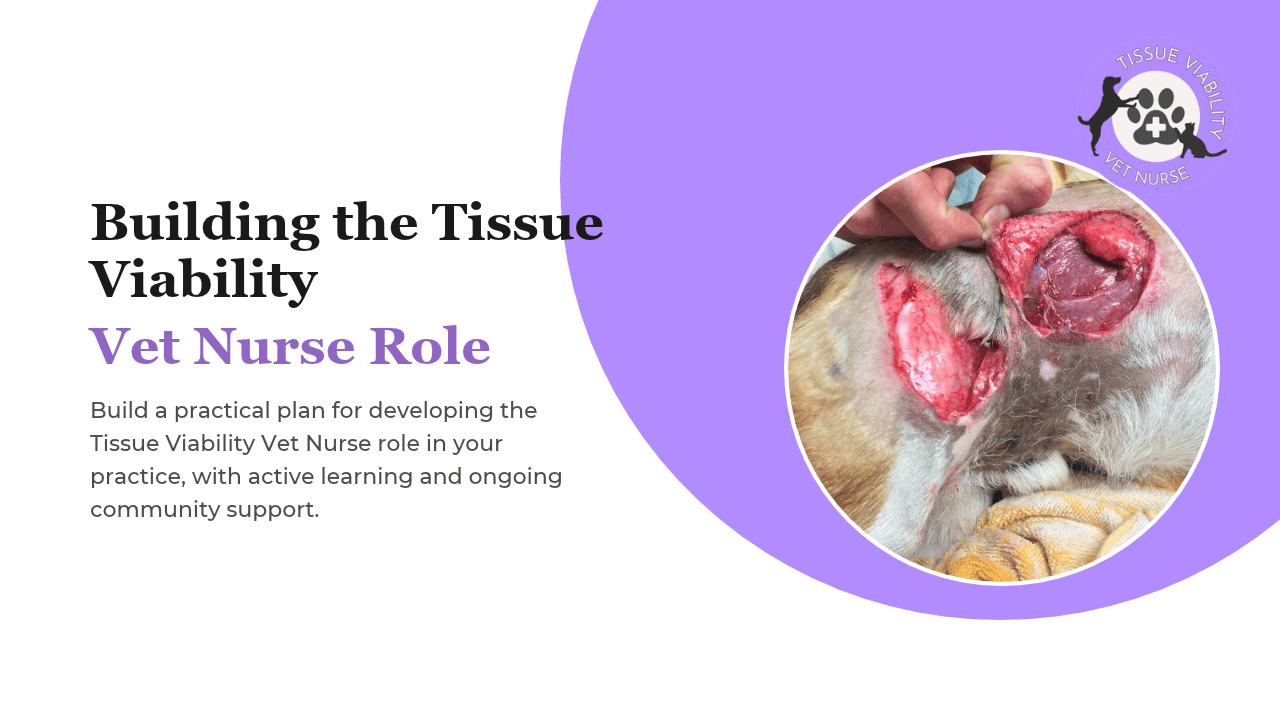
Vet nurses already make an important contribution to wound management, although we do not always recognise the full value of what we bring.
Building the Tissue Viability Vet Nurse Role will help you put structure around that contribution and consider how the role could develop within your own practice.
Through a real clinical case, interactive decisions and guided reflection, you will explore the impact a Tissue Viability Vet Nurse can have on patients, clients and the wider team. You will also consider your current skills and confidence, the boundaries of the role and the practical barriers that can affect change within practice.
As you work through the course, you will create a reflective workbook and a personal action plan. This will help you identify what you already do well, where you would like to develop and the realistic steps you can take over the next 30 and 90 days.
You will also have access to the TVVN Collective community, where you can share ideas, discuss challenges and continue to find support as you begin putting your plan into practice.
Whether you are ready to propose a Tissue Viability Vet Nurse role or are just beginning to explore the possibilities, you will leave with greater clarity, a practical way forward and a community to support you.
Changes within practice take time. The course gives you a practical starting point, a plan you can use and a community to help you keep moving forward.
-
1
 Hello!
-
2
Using your interactive workbook
The interactive workbook is where you will capture your own thinking and gradually build your personal action plan.
-
3
Learning together through the community
The TVVN Collective gives you a place to connect with other veterinary nurses and technicians who are interested in tissue viability and developing their contribution to wound care.


-
6
What is Tissue Viability?
An introduction to tissue viability and the human tissue viability nurse role.
-
7
The principles of the Tissue Viability Nurse role
In human healthcare, the Tissue Viability Nurse role is built around a set of principles that shape how wound care is approached across the patient journey.
-
8
From Principle to Practice
These examples show how the principles of human tissue viability could begin to translate into veterinary practice.
-
11
Legal framework
Appropriate delegation is not based on a procedure name alone. The patient, the person carrying out the task, their competence and experience, the associated risks and the support available must all be considered.
-
12
Role-boundary judgement
The Tissue Viability Vet Nurse role can include a broad range of responsibilities, but this does not mean every wound-related task can be undertaken independently by an RVN.
-
13
Confidence vs Competence
A TVVN may contribute clinically, relationally and organisationally. In this section we think beyond individual procedures and consider how the role can influence the whole patient journey and the wider practice.
-
14
Same task, different support
The task alone does not determine how it should be delegated. In this section we consider factors when delegating and levels of supervision required.
-
15
Where do you sit?
Confidence and competence are related, but they are not the same.
-
16
Barriers
Difficulties with delegation and nurse utilisation are rarely caused by one person being unwilling to change. Here we look at potential barriers to implementation of the TVVN role in practice.
-
17
How would you respond?
-
18
How to respond to barriers
In this section we look at useful responses and approaches to barriers.
-
19
Tackling barriers
-
20
Reflection
The sequence of tackling barriers begins by creating a clear and limited structure, rather than trying to change the whole practice at once.

-
21
Where are you now?
Explore where you currently sit on the TVVN role continuum and identify practical steps to develop your role over the next six months.
-
22
Practice readiness
Assess how ready your practice is to support a TVVN role, identifying existing strengths and areas where systems, processes or team support may need further development.
-
23
Making the case for change
Develop a short business case for one realistic change that could strengthen wound care in your practice, considering the potential benefits for patients, the team and the wider practice.
-
24
Starting the conversation
Practise how you might introduce your idea to a practice lead, exploring how your approach, wording and proposed next steps could shape the conversation.
-
25
Action plan
Bring together your reflections into a practical TVVN action plan, with one achievable next step for the next 30 days and a realistic goal for the next three months.

Course format: Self-paced online learning. Start anytime!
The course includes:
-
an engaging, case-based learning experience;
-
interactive activities and guided reflection;
-
a digital and printable workbook;
-
a personal 30-day and 90-day action plan; and
-
access to the TVVN Collective community for ongoing discussion and support.
Assessment: No formal examination. You will apply your learning through practical activities, reflection and action planning.
CPD: 4 hours
The course is best completed using a desktop or laptop computer so that you can fully engage with the interactive activities and complete your reflective workbook.
You will need:
-
a reliable internet connection;
-
a desktop or laptop computer;
-
an up-to-date web browser;
-
speakers or headphones for video content; and
A printer is optional if you would prefer to complete the workbook by hand.
This course is intended for veterinary nurses and veterinary technicians who:
-
have an interest in wound management and tissue viability;
-
want to develop their contribution to wound care;
-
are considering how a Tissue Viability Veterinary Nurse role could work within their practice; or
-
would benefit from a structured plan for developing their skills, confidence and role.
Learners should hold the professional registration or qualification required to practise as a veterinary nurse or veterinary technician in their own country.
For those practising in the UK, this means being registered with the RCVS. Course content relating to professional scope, delegation and supervision refers to Schedule 3 of the Veterinary Surgeons Act 1966 and current RCVS guidance. International learners should apply the principles in accordance with their own regulatory framework and professional scope of practice.